Unesp 2020 · 2ª fase · 2º dia · Linguagens · Questão 35
Unesp 2020 2ª fase, 2º dia, questão 35 (Inglês): Tira de Jen Sorensen (Summer Refreshment Gentrification): cultura e caráter e mercado imobiliário
Inglês · Interpretação de tira · caderno oficial
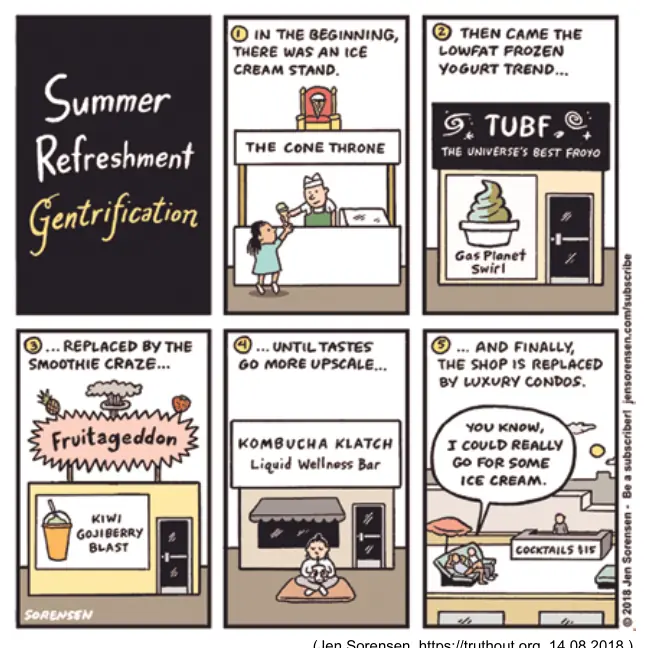
Examine a tira e releia o texto What is Gentrification? (questões 33 e 34) para responder, em português, aos itens a e b.
[Tira em cinco quadrinhos, com o título “Summer Refreshment Gentrification”. 1: “In the beginning, there was an ice cream stand.” (uma barraquinha de sorvete, “The Cone Throne”). 2: “Then came the lowfat frozen yogurt trend...” (loja de frozen yogurt). 3: “...replaced by the smoothie craze...” (loja de smoothies, “Fruitageddon”). 4: “...until tastes go more upscale...” (um bar de kombucha, “Kombucha Klatch – Liquid Wellness Bar”). 5: “...and finally, the shop is replaced by luxury condos.” (um prédio de condomínio de luxo; um morador, na sacada, diz: “You know, I could really go for some ice cream.”)]
(Jen Sorensen. https://truthout.org, 14.08.2018.)
What is Gentrification?
Gentrification is a general term for the arrival of higher-income people in an existing working-class urban district, causing a related increase in rents and property values, and changes in the district’s character and culture. The term is often used negatively, suggesting the displacement of low-income communities by affluent outsiders. But the effects of gentrification are complex and contradictory, and its real impact varies.
Many aspects of the gentrification process are desirable. Who wouldn’t want to see reduced crime, new investment in buildings and infrastructure, and increased economic activity in their neighborhoods? Unfortunately, the benefits of these changes are often enjoyed disproportionately by the new arrivals, while the established residents find themselves economically and socially marginalized.
Although there is not a clear-cut technical definition of gentrification, it is characterized by several changes:
• Demographics: An increase in median income, a decline in the proportion of ethnic minorities, and a reduction in household size, as low-income families are replaced by young singles and couples.
• Real estate markets: Large increases in rents and home prices, increases in the number of evictions, conversion of rental units to ownership (condos) and new development of luxury housing.
• Land use: A decline in industrial uses, an increase in office or multimedia uses, the development of live-work “lofts” and high-end housing, retail, and restaurants.
• Culture and character: New ideas about what is desirable and attractive, including standards (either informal or legal) for architecture, landscaping, public behavior, noise, and nuisance.
(http://archive.pov.org. Adaptado.)